I’ll be honest with you — giving up the bedroom TV was the feng shui change I resisted the longest. I loved falling asleep to something familiar playing in the background. It felt comforting, like company at the end of a long day. But after months of poor sleep, low energy, and a relationship that felt oddly distant, I finally took it out. What happened next genuinely surprised me.
If you’ve been wondering whether having a TV in your bedroom is bad feng shui — yes, it is. But understanding why is what will actually convince you to do something about it. So let me walk you through the full picture, what it’s doing to your space energetically, and what you can do if removing it entirely feels like too big a step right now.
What Feng Shui Says About TVs in the Bedroom
In feng shui, every object in your home carries energy — and that energy either supports the purpose of the space or works against it. The bedroom has one primary energetic job: to be a sanctuary of rest, restoration, and intimacy. It needs to be a deeply yin space — calm, receptive, still, and nurturing.
A television is the opposite of all of that.
TVs emit yang energy — active, stimulating, outward-moving. They are designed to capture your attention, keep you engaged, and prevent you from switching off. That’s great for a living room. In a bedroom, it’s energetically catastrophic. Every time that screen is on, it’s flooding your sanctuary with the exact type of energy you’re trying to wind down from.
But even when it’s off, the problems don’t disappear — and this is where feng shui gets really interesting.
The Problem Doesn’t Stop When You Turn It Off
Most people think the issue is just about screen time before bed. Turn it off an hour before you sleep and you’re fine, right? Not quite — and this is the part that most mainstream sleep advice misses.
In feng shui, a television screen is treated as a mirror when it’s off. That large, dark, reflective surface bounces energy around the room constantly — and mirrors in the bedroom are one of the most significant feng shui concerns in their own right. A mirror facing the bed is said to double the energy in the space, create restlessness, and for couples, invite in a third-party energy that creates distance and tension.
Your switched-off TV is doing the same thing. It’s a mirror you probably never thought to consider.
Beyond that, televisions carry residual energetic charge even in standby mode. The electromagnetic fields (EMFs), the subtle glow of standby lights, the sense of the device being present and waiting — all of it keeps the room in a state of low-level activation that prevents the deep yin settling your nervous system needs for truly restorative sleep.
What a Bedroom TV Is Actually Doing to Your Energy
Let me break this down practically, because the feng shui principles here align remarkably well with what sleep science and environmental psychology tell us too.
It Converts Your Sanctuary Into an Entertainment Zone
The bedroom should have one energetic identity: rest and intimacy. The moment a TV enters, the room becomes a multipurpose space — and your brain starts associating it with stimulation, entertainment, and passive consumption rather than sleep and connection. Over time, just being in the room stops triggering the relaxation response the way it should.
It Introduces Fire Energy
In the five elements framework of feng shui, electronics and screens carry fire energy. Fire is transformative, exciting, and activating — wonderful in the right context. In a sleep space, it overstimulates. Too much fire energy in the bedroom leads to insomnia, irritability, excessive thinking at night, and difficulty winding down even when you’re genuinely exhausted.
It Sits in the Relationship Corner
Here’s something most people don’t know: in the feng shui bagua map, the far right corner of any room from the entrance is the relationship and love corner — associated with the element of earth, partnership, and intimacy. In many standard bedroom layouts, this is exactly where the TV ends up. Placing an active, stimulating, fire-element device in your relationship corner is about as counter-productive as it gets for your love life.
It Replaces Real Connection
Couples who have a TV in the bedroom statistically have less intimacy than those who don’t — and feng shui would say this is entirely predictable. The TV becomes a third presence in the room, absorbing the energy and attention that would otherwise flow between two people. It’s not just a metaphor. In feng shui terms, an active yang device in the partnership space literally disrupts the energetic conditions needed for closeness.
It Keeps Your Nervous System on Alert
Even with the TV off, your brain knows it’s there. It knows it’s available. That low-level awareness — the possibility of turning it on, the habit of reaching for the remote — keeps a part of your mind engaged and alert when it should be fully surrendering to rest. Feng shui describes this as the room holding unresolved active energy — and it’s one of the subtler but more powerful reasons bedroom TVs disrupt sleep quality.
📺 Quick Energy Check — Is Your TV Affecting You?
- Do you fall asleep with the TV on regularly?
- Do you reach for the remote as one of the first things you do in bed?
- Has intimacy with your partner decreased since the TV arrived in the bedroom?
- Do you feel like your bedroom doesn’t quite feel like a retreat?
- Do you wake in the night and find yourself tempted to turn the TV back on?
- Does the room feel stimulating rather than calming when you walk in?
If you checked three or more, the TV energy is almost certainly affecting your sleep, your relationships, or both.
The Mirror Problem — What Nobody Tells You
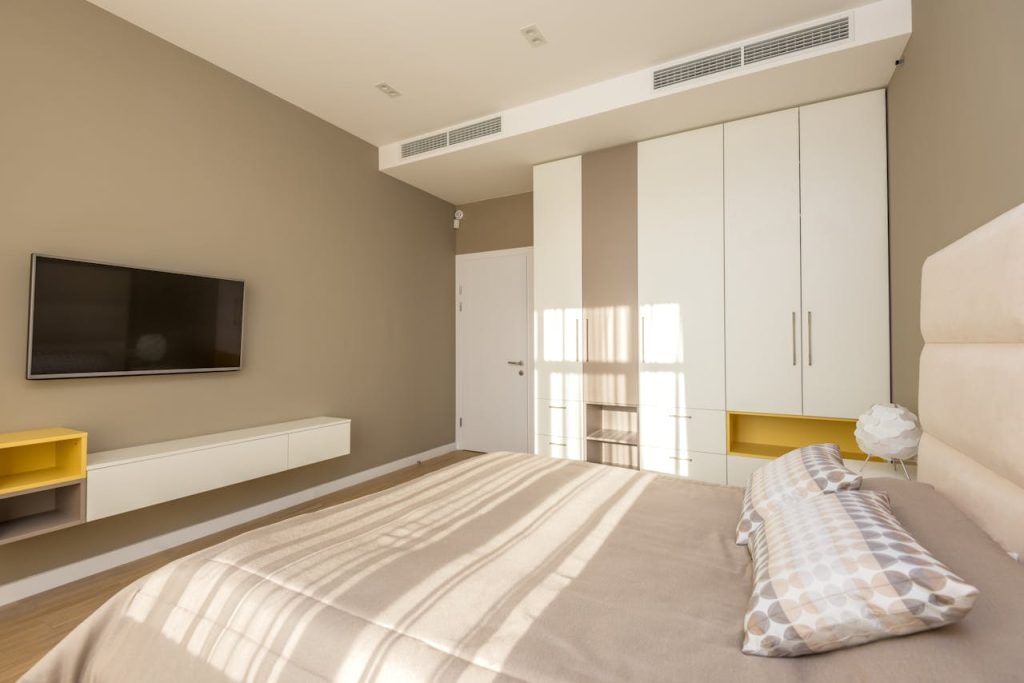
I want to come back to this because it’s genuinely one of the most overlooked feng shui issues in modern bedrooms. We talk a lot about mirrors facing the bed — and rightly so, because that’s a significant concern. But a 55-inch flat screen mounted on the wall opposite your bed is, energetically, a very large mirror.
When you lie in bed, you are reflected in that dark screen. Your movements, your sleeping body, your partner — all doubled in that reflective surface throughout the night. Traditional feng shui teaches that this creates a restless, watchful energy in the room. That sense of being observed, even unconsciously, prevents the deep relaxation and vulnerability that genuine rest requires.
This is also why simply turning the TV off and going to sleep doesn’t fully resolve the issue. The screen is still there. The reflection is still happening. The energetic effect of that mirror continues regardless of whether the device is powered on.
But What If the TV Is Inside a Cabinet?
This is actually a genuinely good feng shui solution, and I want to acknowledge it properly. If you have a TV inside an armoire, a media cabinet, or behind closed doors of any kind, the energetic impact is significantly reduced. The reflective surface is hidden, the device is contained, and the bedroom’s visual field reads as furniture rather than screen.
If you close those cabinet doors every night before sleep, you’ve addressed the mirror problem, reduced the visual stimulation, and contained the yang energy considerably. This is a legitimate middle-ground option that feng shui supports.
What it doesn’t address fully is the habitual energy of the device being present in the room — the fact that your brain knows it’s there and that the EMFs are still emitting. But as a compromise, it’s substantially better than an open, wall-mounted screen.
What About a Fireplace TV or Decorative Screensaver?
Many people now use their bedroom TVs primarily for ambient content — crackling fireplace videos, nature scenes, gentle music visualizers. From a feng shui perspective, this is better than active, stimulating content, but it still doesn’t resolve the core issues of the reflective screen and the yang fire energy of the device itself.
If you genuinely use your TV only for calming ambient visuals and turn it off before you fall asleep, the impact is reduced. But the screen is still a screen, and the room’s energy still registers its presence.
How to Transition the TV Out of Your Bedroom
If you’re ready to try removing it — even just as an experiment — here’s how to make the transition smoother without feeling like you’re giving something up cold turkey.
- Start With a Two-Week Trial
Frame it as an experiment, not a permanent decision. Two weeks is enough time to genuinely notice differences in your sleep, your energy in the mornings, and the feeling in the room. Most people who do this don’t want to bring it back.
2. Replace the Ritual, Not Just the Object
If you’ve been using the TV to wind down, you need something to replace that transition ritual. A few pages of a physical book, a short meditation, a diffuser with lavender or cedarwood, soft music through a small speaker tucked away from the bed — these all support the yin energy your bedroom needs while giving you something comforting to wind down with.
3. Rearrange What’s Left
Once the TV is out, you’ll likely have a wall, a unit, or a bracket to deal with. This is actually an opportunity. Fill that space with something that supports bedroom energy — a soft piece of art that evokes peace or love, a gallery wall of meaningful images, or simply a beautiful piece of furniture. The room will feel noticeably different.
4. For Couples — Make It a Shared Experiment
If your partner is resistant, frame it as a relationship investment rather than a feng shui exercise. Suggest trying it for two weeks with the explicit goal of more connection time before sleep. Most couples notice the difference in their relationship within days — less passive side-by-side consumption, more actual conversation and intimacy.
If You Truly Cannot or Will Not Remove the TV
I respect that not every household can or will make this change. Here’s how to minimize the energetic impact if the TV is staying:
Cover the screen at night. A large piece of fabric, a custom TV cover, or closing cabinet doors removes the mirror effect and signals to the room that the active yang phase is over. This is the single most effective mitigation.
Never fall asleep with it on. Set a sleep timer so it turns off before you’re actually asleep. Falling asleep to a screen means your brain never fully transitions into the deep yin state it needs.
Keep it off the wall opposite the bed. Position the TV so that when you’re lying down, you’re not reflected in the screen. Off to the side is always better than directly facing you.
Add grounding elements nearby. Earth-element objects — ceramics, crystals like black tourmaline or smoky quartz, natural wood — near the TV help counterbalance its fire energy. They won’t neutralize it entirely, but they shift the elemental balance of the room meaningfully.
Create a clear visual boundary. Use furniture, curtains, or a room divider to create a subtle visual separation between the TV area and the sleeping area. Even a symbolic boundary helps your brain register two different energy zones within the same room.
My Honest Take
Removing the bedroom TV was the change I was most resistant to and the one that made the most noticeable difference. The room felt different almost immediately — quieter in a way that wasn’t just about sound, more like mine in some way I couldn’t quite articulate. My sleep deepened. The relationship conversations that had been getting shorter and more perfunctory started getting longer again.
I’m not going to tell you the TV was the cause of everything. But it was contributing to an environment that didn’t fully support rest or connection — and that matters, night after night, year after year.
Your bedroom is the room you spend more time in than any other. It shapes how you feel when you wake up, how you relate to the person beside you, and how well your body actually restores itself. It’s worth protecting that space with some intention.
The TV can live in the living room. It will be fine there.
Frequently Asked Questions
Is it bad feng shui to have a TV in the bedroom?
Yes — a TV in the bedroom introduces active yang energy into a space that needs to be calm and yin. It also acts as a large mirror when switched off, bouncing restless energy around the room. From a feng shui perspective, the bedroom should be reserved for sleep, rest, and intimacy — and a television works directly against all three of those purposes.
Does a TV count as a mirror in feng shui?
Yes. When a TV is off, its dark reflective screen functions energetically as a mirror in feng shui terms. If it faces the bed, it doubles the energy in the room and creates the same restless, watchful quality that mirrors facing the bed are known for. This effect continues throughout the night regardless of whether the TV was used that evening.
Where should a TV go if not in the bedroom?
The living room is the ideal home for a television — it’s a yang, social, activity-oriented space where that energy is appropriate and welcome. If you live in a studio apartment and the TV must share the bedroom space, place it inside a cabinet with doors you can close at night, and position it so the screen does not reflect the bed.
Can a TV in the bedroom affect your relationship?
Yes, and this is one of the most commonly reported effects. In feng shui, the TV introduces a disruptive third-party energy into the most intimate space in the home. It also tends to occupy the relationship corner of the room on the bagua map. Practically speaking, it replaces connection time with passive consumption. Many couples report meaningful improvement in their intimacy and communication after removing the bedroom TV.
What if I cover the TV at night — does that help?
Yes, significantly. Covering the screen at night removes the mirror effect, contains the yang energy of the device, and signals to both the room and your nervous system that the active phase is over. It’s one of the most effective mitigation strategies if removing the TV entirely isn’t an option. Use a cloth cover, a decorative panel, or cabinet doors.
What can I replace the bedroom TV with for winding down?
Great yin-energy alternatives for your bedtime wind-down ritual include: a physical book or journal, a diffuser with calming essential oils like lavender or sandalwood, soft ambient music from a small speaker placed away from the bed, a gentle stretching or breathwork practice, or simply a meaningful conversation with your partner. All of these support the bedroom’s energy rather than working against it.
Does the size of the TV matter in feng shui?
Yes — the larger the screen, the larger the mirror effect and the greater the yang energy presence in the room. A small 24-inch screen in a cabinet is substantially less disruptive than a 65-inch wall-mounted display facing the bed. If you’re going to have a TV in the bedroom, smaller and contained is always better from a feng shui perspective.